
Toy Story Gameplay
Toy Story on Sega doesn’t win by brute force; it runs on nerves and timing. You slip into Woody’s boots, and the trick isn’t smashing — it’s threading needles, grabbing edges, and locking into a rhythm. This movie tie-in platformer lives in the small stuff: the yo-yo string cracks like a lasso, shelf hooks beg for a careful leap, and the floor beneath you either springs like a toy ball or treacherously slides away. From the first stage, it teaches you to play by ear and feel, like an instrument: don’t lunge — breathe with the metronome in your head, listen for footsteps behind the door, watch the screen flicker — and move the instant it clicks.
Woody in Toy Story isn’t a wrecking-ball hero. He slips the gaps. The string is a trusty lasso: snap — the wind-up robot freezes for a second; snap — you snag a hook under the shelf, swing forward, and land right on the edge of a box of bricks. Constant changes in height, swaying ropes, runaway trolleys — not “traps,” a dance. Hit the button on the beat and you’re through. Rush it and a tiny toy life flies off-screen while you’re already replaying the run in your head, asking where you hurried and why.
The game keeps tossing setups where one wrong step means replaying a chunk. Andy’s room: a warning flickers, someone’s coming, and Toy Story morphs into a bite-size stealth puzzle. You dart under a cup, tuck behind blocks, freeze when a shadow glides across the floor. Heart thumping, an inner timer tapping quarters, you wait out the danger. Then — back to the star-marked ball, a soft bounce, and up to the shelf where the key to the next door is hiding.
Green army men clatter in tinny boots, and the level seems to whisper orders. Haul batteries, signal a rope, lend a hand — the whole screen pops with little set pieces. In moments like these the “Woody and Buzz” game feels smart: it doesn’t shove, it nudges. It’s not “farm secrets for points,” it’s “notice how this world is built,” and clearing Toy Story on Sega becomes natural — step to step, accent to accent.
Tempo shifts keep you wired. That sudden duel with Buzz isn’t about haymakers; it’s two stubborn temperaments colliding. The camera locks to a stage, the floor trembles under your jumps, and every shove lands like a line of dialogue. You slip off the centerline on time, bait a whiff, spring off the ball, and ease him back to the edge. Flashy, a little mean, and delightfully gamey: you read the boss’s rhythm from movement the way a drummer reads the stick.
Then the game flips the table. The RC car buzzes, the battery drains, and Toy Story turns into a time trial. You pick up batteries on the racing line, hop over blocks, snake around pencils, and suddenly a road appears as if cut from carpet. The RC handles feather-light yet stubborn, and if the platformer made you measure every step, here you hold the flow. No cluttered HUD, no pop-up tips — just you, the tire hiss, and the sense that any second could be decisive. That’s why beating a stage against the clock here is its own reward.
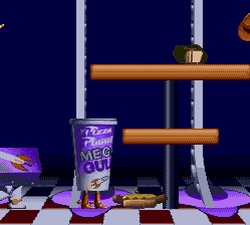
Pizza Planet smells like sticky soda and neon. Between tables lies a maze where you don’t sprint so much as bide your time, duck behind boxes, and orbit the claw machine. That crane is its own beast: the claw slides out lazily, a predator leaving its den, sizes you up inch by inch, and you sway the rigging, skip past belts, dash underneath while luck still holds. The scene isn’t carried by raw difficulty but by nerve: one misstep and that plastic talon snags your hat. Here Toy Story boldly bends the rules without breaking the groove.
Sid’s house plays a different tune. Pipes, firecrackers, sparking lights, tape, and strange toy hybrids that act less like enemies and more like riddles. You shave corners, nudge a minecart, find a post to catch with your string, and sprint before the fuse burns down. Out in the yard lurks Scud, and your lasso won’t save you: only speed, clean jumps, and knowing exactly where to land. These are survival levels, so the final backyard chase — wind screaming, bins and crates in your path — sticks like a tiny thriller.
The game keeps changing angles. One minute it’s a cozy shelf-hopping platformer, then an almost arcade chase, then a puzzle vignette in a cabinet, then a full-on stress test in Sid’s place. Inside the shuffle sits a solid spine: snappy Woody controls, readable jump physics, and that ever-reliable string. So when Toy Story suddenly asks you to rocket-ride and catch a gust through the window, you don’t panic. You hold your line, feel the inertia, and still spot the fleeting bits — a sticker on the wall, a blinking bulb, aliens whispering about “The Claw.”
The difficulty climbs fair and square. There’s no lottery feel: every loss makes sense, and every retry isn’t “one more go,” it’s “this time, cleaner.” That’s why a Toy Story Genesis/Mega Drive run may look like hopscotch across a kid’s room, but inside it’s pure rhythm action. Learning when to brake and when to blast again, you hit a little zen: you count bars without thinking, steady your breathing, and bosses stop being scary. Their patterns read like lines of text, and the chance to bail out your friends nudges you to push where you usually ease off.
For all the discipline, it leaves room for small joys. Climb where the game doesn’t exactly invite you and snag an extra star. Ride a moving box farther than necessary, just to see what’s beyond. Sketch your own route through a stage — and feel how Toy Story on Sega quietly blesses the experiment. That lovely organic feeling where secrets don’t fall out of a menu, they hide at the edge of your gaze, and you find them simply because you’re curious.
In the end, Toy Story — our at-home “Toy Story,” the same one we grew up with — rests on a rare pairing: careful precision plus a spark of bravado. Every stretch plays like a tiny character scene, and when your thumbs land that clean take, you get why this game is remembered by feel. Not by pixels or quotes, but by the same tight wire humming through the Buzz duel, the claw sequence, the RC dash, and Sid’s yard while the dog growls somewhere behind and you’ve got exactly one shot to clear that crate.