
History

Toy Story on Sega — that cartridge-era Toy Story that kicked off mornings with Woody yanking his pull-string like a lasso and the first ping of the title-screen jingle. This Disney and Pixar licensed, side-scrolling platformer taps that exact childhood thrill: Andy’s room is a jungle, the bed’s a mountain, toys spring to life, and every step is an adventure. People called it all kinds of names: "Toy Story," "Woody & Buzz on Sega," "the game from the movie," sometimes just "Toy Story" on the Mega Drive/Genesis. It nails that rare "living bedroom" vibe: crawling under the bed, freeing pals from boxes, taking RC for a spin, hiding from Sid, and finally rocketing toward Andy’s place — not as a spectator, but as part of the action. It’s more than a tie-in; it’s a carefully cut, cinematic carousel of bite-size set pieces, with pace shifts — from stealthy sneaks to white-knuckle sprints — that glue your hands to the gamepad. You can almost smell the cardboard from the cart box — the world dares you to buy in.
Launched in 1995 at the peak of the 16-bit era, living rooms hummed with Segas and shelves stacked carts with neat "Toy Story" stickers. With Traveller’s Tales and Disney Interactive at the helm, the craft shows: varied levels, elastic spritework, and music that holds the mood. For many, the Sega Mega Drive/Genesis edition became the definitive version — the after-school comfort run, back to hopping over block pyramids and grabbing Buzz by the hand. Flea markets sold it as "Toy Story: the movie game," video clubs pitched "Woody & Buzz’s adventures" — and it stuck as the neighborhood’s childhood classic. Read how it landed and why it stayed in our short release history, and check dates and facts in the Wikipedia article.
Gameplay
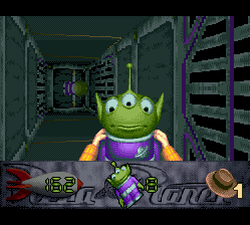
In Toy Story on the Sega Genesis (Mega Drive) — the one everyone just called the Woody-and-Buzz game — it plays like a brisk, cartoony side-scrolling platformer. You’re in Andy’s room and the world suddenly towers over you: letter blocks turn into walls, tables stretch up like skyscrapers. The rhythm keeps you wired: build momentum, stick a precise jump onto the ball, bounce off the bed, swing from a hook — and on you go, Woody’s lasso rope trembling in his hands. Enemies aren’t scary one-on-one, but the little things tighten the screws: springboards launch you, shelves shuttle up and down like elevators. It rarely lets you switch off: timing and dexterity rule, and once you lock into the groove you start sliding through a level almost like a dance.
From there it keeps flipping the vibe, like a run of theme-park attractions. After the home sprints comes Pizza Planet: hiding under cups and boxes turns into breezy stealth where you slip between conveyor cycles. Then the RC race: a top-down dash, batteries ticking down, and you can feel those plastic tires bite into the corner. Next up — The Claw: pseudo-3D inside the cabinet, all shiny plastic and a jittery scramble for an exit amid squeaky little aliens. By the finale, the tempo spikes: a moving-day obstacle course, a frantic chase, and that rocket ride. Secrets wink at you along the way — stars, extra lives, tiny pickups that just make you smile. It’s one of those rare movie tie-ins that doesn’t just trace the film; it brings back the thrill of adventure at toy scale. Toy Story asks for focus and rhythm: step, jump, swing — and go. You’ll want to hit Start again, and we’ve packed the details into our gameplay breakdown — short and sweet.